
Tag Archive for: StartHub Africa

Imagine a world where learning explodes with vibrant colours, where every lesson is an artistic adventure. This isn’t just a dream; it’s the reality FunLearn is creating!

Funlearn isn’t your typical classroom. Led by the visionary Baliira Rodney, Funlearn is a kaleidoscope of artistic and academic threads woven together to craft an educational experience that ignites imaginations.

But why? Because traditional education often overlooks the power of modern, creative approaches to learning. Funlearn believes every student has a wellspring of creative potential, just waiting to be unlocked!

Baliira Rodney CEO and Founder of FunLearn Club

Baliira’s story itself is a testament to the transformative power of education. With a burning passion for art, they were stifled by the limitations of traditional art classes. The high costs and outdated curriculum made exploring digital art and animation a distant dream. This frustration became the seed of Funlearn: a platform designed to make modern art education accessible, engaging, and, most importantly, fun!

What makes Funlearn unique? Forget dull lectures! Funlearn is all about dynamic, interactive learning. They offer a vibrant range of digital art courses, from animation design to web development, all designed to captivate imaginations and empower students to unleash their creativity through multimedia engagement.

This innovative approach hasn’t been easy. Funlearn, like any startup, has navigated the ever-changing landscape of education. They began as a school club, a spark of artistic exploration for students. From there, they partnered with schools to integrate their courses into curriculums. Today, they offer short courses for adults, fostering a love for lifelong learning and skill development.

Baliira Rodney and his colleagues

Of course, there have been challenges. Initial resistance from schools and educators was a hurdle, but Funlearn met it head-on. By engaging teachers and introducing curriculum-aligned competitions, they’ve earned a place in the education community.

This success wouldn’t be possible without the invaluable support of StartHub, a guiding light on Funlearn’s path. StartHub’s mentorship, strategic guidance, and financial support have been essential for growth and impact.

The future of Funlearn is brimming with ambition. They envision a physical mega-school, a haven for comprehensive education in digital art, IT, and innovation. Their goal? To become a global leader in creative education, empowering students worldwide to unlock their creative potential.

Baliira Rodney sharing knowledge with students

Funlearn isn’t just about teaching art; it’s about nurturing innovation. By instilling creative problem-solving skills from a young age, they’re shaping a future generation of innovators and entrepreneurs. They want students to see education not as memorising facts, but as a gateway to imaginative thinking and real-world impact.

Are you ready to join this exhilarating adventure? Whether you’re a student yearning to explore your artistic side or an educator passionate about fostering creativity, Funlearn has a place for you. Together, let’s unlock the limitless potential of education and unleash the transformative power of creativity!

click here to learn more about FunLearn http://www.funlearnclub.com
We’re thrilled to announce StartHub Africa as the official Implementing Partner for the Stanbic National Schools Championship (NSC) 2024, Season 9! This prestigious initiative, spearheaded by Stanbic Bank, aligns perfectly with StartHub’s unwavering commitment to fostering innovation and entrepreneurial spirit within Ugandan schools. 

Why is StartHub a Perfect Fit for the NSC? 

At StartHub, fostering the next generation of entrepreneurs in Africa is at the core of everything we do. We believe that young minds hold immense potential, brimming with creative ideas and the drive to make a difference. The NSC aligns perfectly with this vision, providing a platform for students to develop their entrepreneurial spirit and turn their innovative ideas into reality. 

Apply Here: https://stanbicnsc.ug  

StartHub is dedicated to equipping young Ugandans with the skills and resources they need to succeed in the ever-evolving world. Through the NSC, we’ll be actively involved in the following: 

Curriculum Development: We’ll play a key role in refining the program’s curriculum, ensuring it equips students with the latest knowledge and practical strategies for entrepreneurial success. 

Mentorship and Training: Our network of experienced mentors will guide and support participating students, providing invaluable insights and guidance throughout the competition. 

Bootcamp Facilitation: We’ll be actively involved in designing and delivering the intensive bootcamp program, a crucial phase where top student teams hone their business acumen and refine their competitive edge. 

StartHub is honoured to work with Stanbic Bank Uganda in this impactful initiative. We recognize the significant role Stanbic plays in driving social and economic development in Uganda, and the NSC serves as a powerful testament to this commitment. Through our combined efforts, we can empower young Ugandans to become the architects of their own success and contribute meaningfully to the nation’s future. 

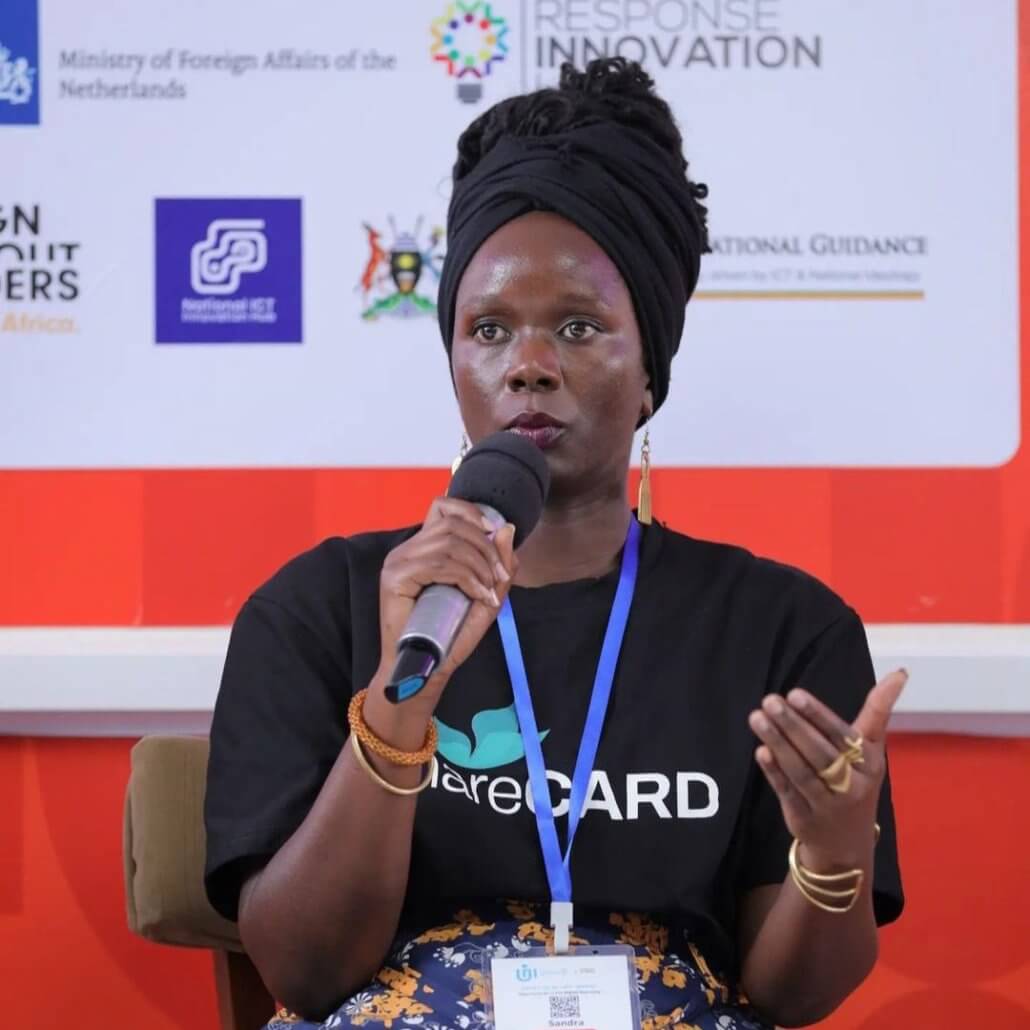
In the fabric art of social innovation, ShareCARD’s tale shines brightly, empowering organizations with the intricate threads of data intelligence to weave impactful projects and effectively reach beneficiaries. Steering the course of this transformative journey is Sandra Awilli, the co-founder and lead innovator of ShareCARD, whose vision and resilience have propelled the company from humble beginnings to the forefront of social innovation.

Sandra Awilli, CEO and co-founder of ShareCARD

ShareCARD’s inception was rooted in a mission to address a pressing societal need: the lack of access to menstrual hygiene essentials for girls, particularly during the challenging lockdown period. The company’s inaugural initiative, PadShare, emerged as a beacon of hope amidst adversity, serving as a pilot project to democratize access to sanitary pads. Notably, ShareCARD’s groundbreaking efforts garnered acclaim, clinching the top prize at the 1st EU Global Hackathon between 2020 and 2021, a testament to its innovative approach and unwavering dedication.

Sandra Awilli, at the EU Global Hackathon Summit in Morocco
Sandra Awilli at the EU Global Hackathon submit in Morocco

At the heart of ShareCARD’s mission lies its commitment to leveraging technology for social good. The company offers Software as a Service (SaaS) solutions focused on data management, providing organizations with real-time insights into project progress and beneficiary services. With customizable dashboards and inclusive features like beneficiary cards, ShareCARD empowers users to streamline data collection and analysis, bridging the gap between online and offline environments.

Like many startups, ShareCARD navigates a challenging terrain on its path to success, Sandra, a non-technical founder, encounters difficulties in finding skilled engineers and securing funding in Uganda’s competitive market. However, through perseverance, personal growth, and strategic networking, ShareCARD overcomes these obstacles, with organizations like StartHub playing a pivotal role in providing guidance and support along the way.

 Sandra dreams of a future where ShareCARD empowers positive change and lasting progress, fueled by the illuminating power of data. With ambitious goals for revenue growth, team expansion, and market penetration, ShareCARD aims to establish itself as a leading force in shaping data management policies and influencing key decisions at all levels. Through collaborative efforts and innovative initiatives, ShareCARD is poised to make a tangible impact in communities across Africa and beyond.

ShareCARD participating  at the Uganda Innovation week
ShareCARD participating in the Uganda Innovation Week

As ShareCARD embarks on its journey towards a brighter future, one thing remains abundantly clear: the power of data to drive meaningful change cannot be overstated. Through their unwavering commitment to leveraging technology for social good, ShareCARD is not just revolutionizing the way organizations manage data; they are empowering communities, transforming lives, and paving the way for a more equitable and sustainable future. In the landscape of social innovation and impact-driven enterprises, ShareCARD stands as a beacon of hope, inspiring others to harness the power of data to create a better world for all.

ShareCARD is among the many startups that have been nurtured through the StartHub Africa Catalyzer program, a venture-building program that helps businesses grow faster.

In the ever-evolving realm of social entrepreneurship, few narratives carry as much resonance as that of Zetu Africa, an innovative enterprise committed to reshaping the landscape of education and design. At its helm stands Arnold Leon Mugagga, the Managing Director of Zetu Africa and Co-Founder of Zetu Foundation, whose unwavering commitment to social impact has propelled the company from its inception to remarkable heights. 

Arnold Leon Muggagga
Arnold Leon Muggagga, Managing Director of Zetu Africa

Zetu Africa’s journey began in 2019 with a simple yet revolutionary idea: the SeatPack. Inspired by the dire conditions faced by students in schools across Uganda, Arnold and his team embarked on a mission to provide sustainable alternatives to traditional classroom furniture. Through tireless research and experimentation, they developed the SeatPack—a school bag that transforms into a chair with a writing surface, offering children a portable and stable learning environment. This innovative solution not only addresses the pressing issue of inadequate classroom furniture but also contributes to environmental conservation efforts by utilizing recycled materials. 

As with any startup, Zetu Africa faced its fair share of challenges along the way. From implementing efficient production systems to managing competition in the market, the journey has been marked by perseverance and dedication. Through strategic partnerships with organizations like StartHub, Zetu Africa has been able to overcome these obstacles, leveraging resources and expertise to drive innovation and growth. 

Zetu Africa
Pupils using SeatPacks in class

At the core of Zetu Africa’s mission lies a commitment to driving impact through innovation. By providing sustainable alternatives to traditional products and fostering a culture of design thinking, the company is transforming education and design across Africa. Through initiatives like the Zetu Foundation, Zetu Africa extends its impact beyond profit-making activities, channeling part of its profits towards philanthropic endeavors and distributing SeatPacks to schools in need. 

In envisioning the future of Zetu Africa, Arnold sees a world where millions of children benefit from SeatPacks distributed through the Zetu Foundation and millions of Africans incorporate Zetu-designed and built products into their daily lives. With a steadfast commitment to innovation and social impact, Zetu Africa is poised to shape a brighter future for communities across the continent. 

Zetu Africa
At one of the Zetu Africa workshops

The Zetu Africa story is evidence of the power of entrepreneurship to drive meaningful change in society. Through their innovative solutions and unwavering commitment to social impact, Arnold and his team are reshaping the landscape of education and design, one SeatPack at a time. As they continue their journey, Zetu Africa serves as an inspiration to entrepreneurs everywhere, demonstrating the transformative potential of business as a force for good in the world. 

Zetu Africa is among the many startups that have been nurtured through the StartHub Africa Catalyzer program, a venture-building program that helps businesses grow faster.

StartHub Africa has different programs including the academy and catalyzer programs. In both of these programs, startups are taught basic business operations. One common feature in all these programs is design thinking. At StartHub, we emphasize it a lot for all entrepreneurs. 

But StartHub isn’t the only organisation that is big on design thinking. It is a major feature of global giants like Apple, Google, Samsung and General Electric among others. It is also being taught at the best universities in the world like Stanford, Harvard and Massachusetts Institute of Technology (MIT).

What is design thinking?

According to Interaction Design, design thinking is an iterative process in which we seek to understand the user, challenge assumptions, and redefine problems in an attempt to identify alternative strategies and solutions that might not be instantly apparent with our initial level of understanding.

Essentially, design thinking is all about the journey from having an idea in your mind as an entrepreneur to building a market fit product. When every entrepreneur comes up with this big idea, they rely on assumptions of the market from who will be their customers, who are willing to pay for the product and how creative is the solution.

The design thinking process helps the entrepreneur to throw away these assumptions and build a product based on actual feedback and insights from potential users. The Hasso-Platner Institute of Design at Stanford, one of the schools at the forefront of applying and teaching design thinking, came up with 5 stages of the process. Let’s explore them below.

Stage 1: Empathize

The entrepreneur has to empathize with their users. This is basically putting yourself in their shoes and trying to reason from their perspective.  This is the first stage of design thinking. Once an entrepreneur is able to empathize with their users, they can move on to the next stage. 

Stage 2: Define your users’ needs.

The users, needs are defined by interviewing potential users. Through interviews, one can know what their problems actually are. This stage also helps the entrepreneur to pinpoint what his target group of customers is going to be based on insights received. It is important to compare your findings here with your assumptions. 

Stage 3: Ideate.

At this stage, the entrepreneur should have moved on from the assumptions they had and actually have an idea of what the users truly want. This stage is for the entrepreneur to come up with a solution to the problem that he identified in stage 2, a solution that can cater for the users’ needs. 

An Ideation Session. Image Credit: Unsplash Copyright terms and licence: Free to Use

Stage 4: Prototype.

It is now time to build something the users can use. There are various ways to build a prototype. You can use tools like Canva, inVision, SAP and Marvel among others. You should build something that potential users can test and get a view of how the solution you came up with will work. 

Stage 5: Test.

Test your prototype with various users. Takedown the feedback they give you and use it to refine your prototype even further until you have one that they can use. When you are confident of your prototype, then you can move on to development. 

Why is Design Thinking important? 

Startups are known for innovation and invention. Most of them are building solutions that have never been tested or done before. This makes it a virgin field and hence, assumptions are what fill in for facts. It is on the entrepreneur to replace those assumptions with facts before developing their startup. 

Design thinking helps entrepreneurs to minimize losses on their investment. One of the biggest killers of startups is building something no one wants or something that no one can use. This is why it is important for any entrepreneur to go through this process. Design thinking gives the entrepreneur a better chance of building a successful startup. 

This is why we have made design thinking a very important tool in all our programs, here at StartHub.

© Copyright 2022 StartHub Africa